AI-powered insurance brokerage startup raises $46.8 million
Harper, an AI-based insurance brokerage startup, has raised $46.8 million in a combined Series A and seed funding round, the company recently announced.
5 days ago - Business
Business
Economists question whether monetary tightening can succeed while the central bank continues to inject funds into banks
By Admin User
Jul 1, 2026 - 1 min read
Every monetary policy comes with trade-offs. And the Monetary Policy Statement (MPS) the Bangladesh Bank unveiled yesterday is no exception.
One of its biggest dilemmas is that the central bank is trying to cool stubbornly high inflation while simultaneously injecting money into the economy through several channels.
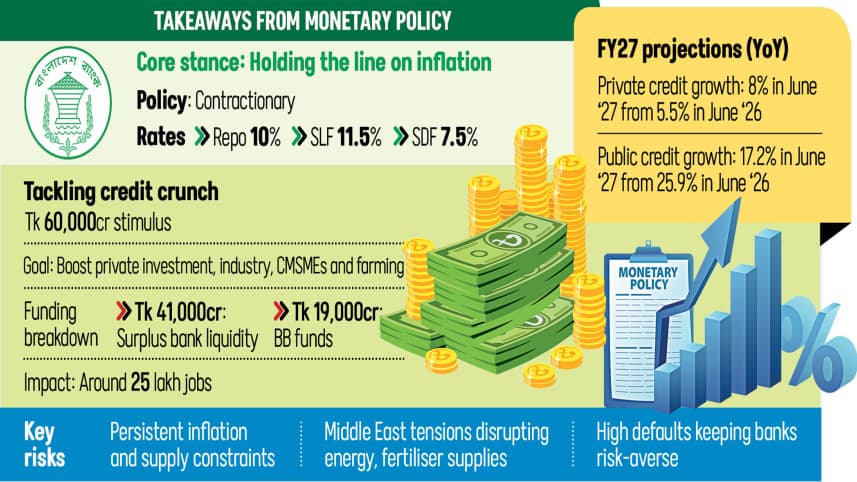
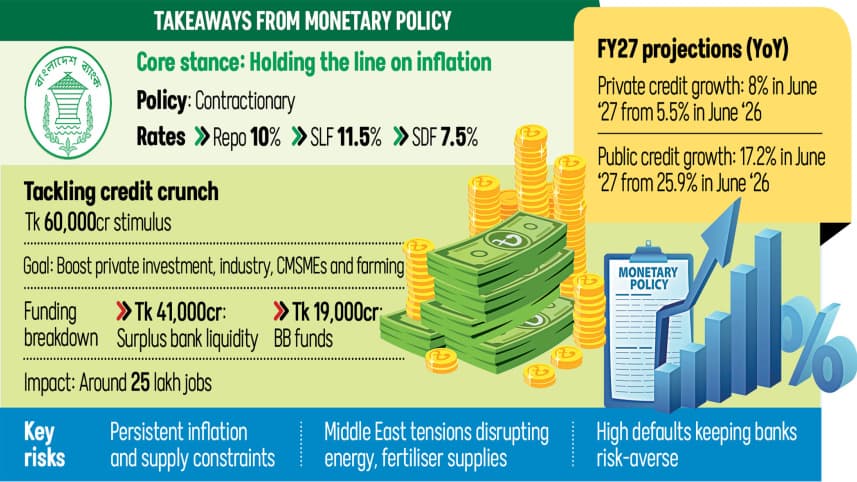
<div>Identifying near double-digit inflation as its biggest challenge, the BB kept the policy rate, its benchmark lending rate, unchanged at 10 percent for the July-December period.</div><div><br></div><div>The policy rate, also known as the overnight repurchase rate, is the rate at which commercial banks borrow from the central bank. It has remained at 10 percent since October 2024 after 11 consecutive increases between May 2022 and October 2024.</div>
<div>The Standing Lending Facility (SLF) rate will remain at 11.5 percent, while the Standing Deposit Facility (SDF) rate will stay at 7.5 percent.</div><div><br></div><div>Despite the BB maintaining a contractionary monetary policy for years, inflation has remained above 9 percent. It stood at 9.42 percent in May, the highest level in 16 months and well above the central bank’s 7.5 percent target for fiscal year 2026-27.</div><div><br></div><div>Economists say the impact of high interest rates has been diluted by BB’s continued liquidity support to weak banks and its purchases of US dollars from the market. Together, these measures have softened the effect of tighter monetary policy.</div>
Harper, an AI-based insurance brokerage startup, has raised $46.8 million in a combined Series A and seed funding round, the company recently announced.
5 days ago - Business

Temple is a wearable technology company that describes itself as focused on elite performance and precision monitoring. In a recent hiring post on X, Goyal stated that the core product is a performance-tracking wearable aimed at athletes
5 days ago - Business